Only one of Malaysia's oil states is rich on paper. It's the one whose households aren't.
Sarawak produces 29% more per person than the national average and earns 22% less per household. Sabah and Terengganu don't fit the pattern at all.
Receipt 01Gross Domestic Product (GDP) by State, 2024
RM73,426
Sarawak's GDP per person, 2024, at current prices
29% above the national RM56,734
Receipts — what this piece rests on
There is no named author on this piece. The documents above are the byline — check them.
“If Petronas is indeed for all Malaysians, why are the oil-producing regions and states poorer than the non-oil-producing states?”
A viewer asked this under a video about Petronas and Petros, and 67 people upvoted it:
If Petronas is indeed for all Malaysians, why are the oil-producing regions and states poorer than the non-oil-producing states?
We went to check. The answer turned out to be more interesting than the question, because the pattern the question describes is real in exactly one state — and it is not real in the other two.
Sarawak: the state the question is actually about
In 2024, Malaysia's GDP per capita was RM56,734. Sarawak's was RM73,426 — about 29% higher, the highest of any state outside the federal territories bar Penang.
GDP per capita by state, 2024
In the same year, Malaysia's median monthly household income was RM7,017. Sarawak's was RM5,504 — about 22% lower. Nine states had higher median household incomes.
Median monthly household income, 2024 — same places, same order
The cleanest comparison is Selangor. Selangor produces less per person than Sarawak — RM65,907 against RM73,426 — and its households take home almost twice as much: RM10,726 against RM5,504. Sarawak is the only state in Malaysia that sits well above the national average on output and well below it on household income. Every other high-output state is also a high-income state.
So for Sarawak, the premise holds, and holds hard.
Sabah and Terengganu break the pattern completely
Here is where the popular version of this argument falls apart.
Sabah's GDP per capita in 2024 was RM30,605 — not high at all. It is 46% below the national average, the fourth-lowest in Malaysia after Kelantan, Perlis and Kedah. Sabah is not a state that looks rich on paper and poor in the payslip. It looks poor on both. Its median household income was RM4,890, third-lowest in the country. Its absolute poverty rate was 17.7% against a national 5.1% — the worst in Malaysia by a wide margin, and more than three times the national rate. Its unemployment rate was 7.6%, also the highest, against a national 3.2%.
Terengganu inverts the pattern outright. Its GDP per capita was RM32,442, 43% below the national average — but its median household income, RM6,627, was only 6% below national. Relative to what Terengganu produces, its households do better than the Malaysian average, not worse.
Gross Domestic Product (GDP) by State, 2024
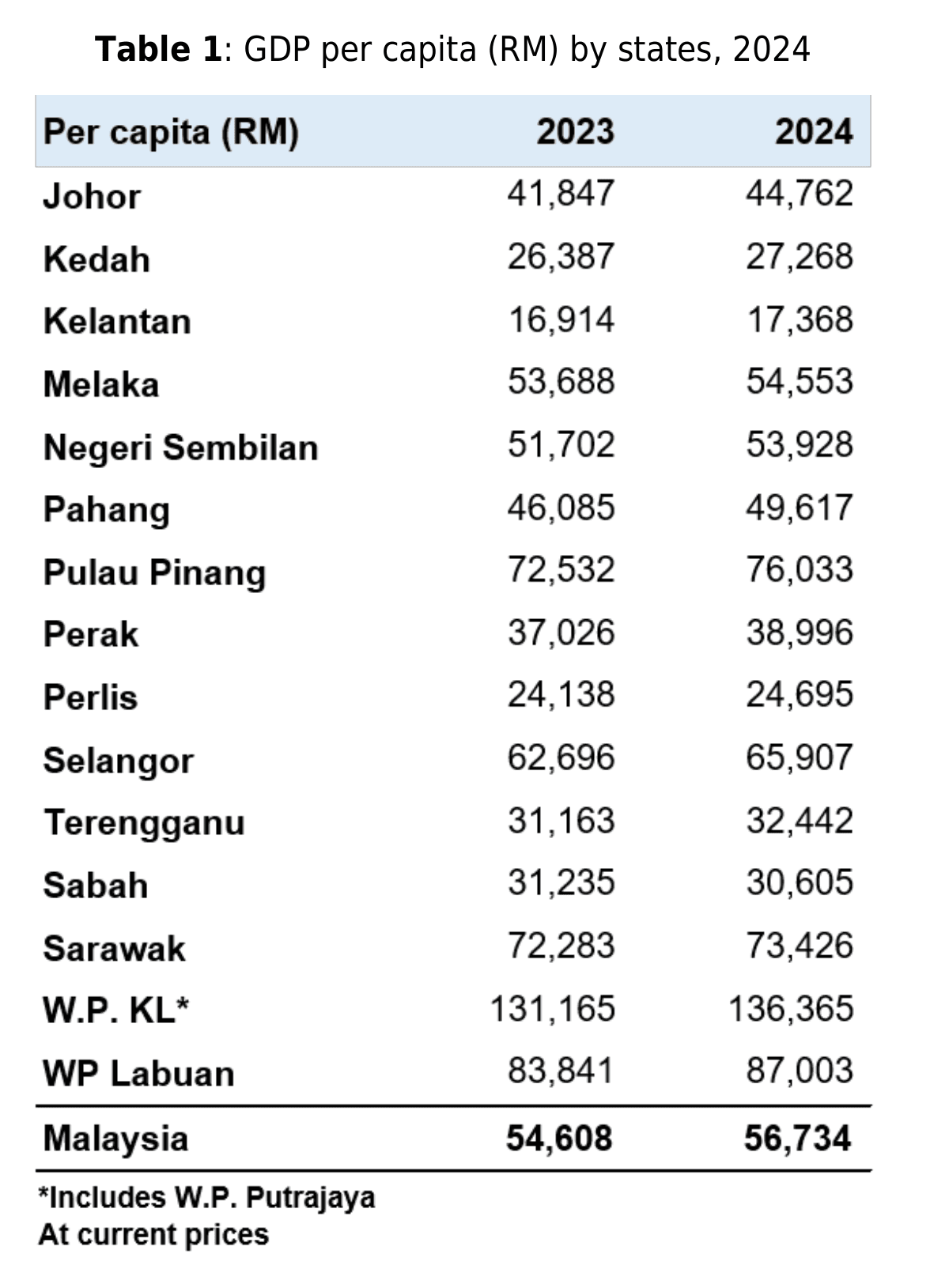
“Terengganu 31,163 32,442 · Sabah 31,235 30,605 · Sarawak 72,283 73,426”
Three oil states, three completely different shapes. Any argument that treats "the oil states" as one aggrieved bloc with one statistical signature is not describing the data.
The reason is a category almost nobody has heard of
Terengganu is an oil state whose mining and quarrying sector is 0.6% of its own economy. That sounds impossible. It isn't, and the explanation is the most useful thing in this article.
DOSM's state accounts contain a category called Supranational, which the department defines as "a catch-all category for GDP data that cannot be attributed to a specific state, especially in the mining and quarrying sector." In plain terms: output from offshore fields that sit in no state's territory.
In 2024, Supranational held RM44.5 billion of mining and quarrying output — 45.1% of Malaysia's entire mining sector, and 100% of Supranational's own GDP, because that is all it contains. Sarawak accounted for 31.7% and Sabah for 18.8%. Between those three, 95.7% of the country's mining output.
Where Malaysia's mining and quarrying output is booked, 2024
That single fact reorganises the whole argument:
- Offshore output is credited to no state at all. Not to the state whose coast it sits off, not to the state that consumes it. It sits in a bucket.
- Terengganu's oil is offshore, which is why its state accounts show RM238.5 million of mining output against Sarawak's RM31,306.8 million. Terengganu's oil is real; it just never enters Terengganu's GDP.
- Sarawak's 21.1% and Sabah's 22.0% mining shares are the attributable remainder — the part the accounts can place on land or in state waters.
So "the oil money doesn't show up in our state" is, for offshore production, literally and mechanically true at the level of national accounting, before any question of politics or fairness arises. And it means GDP per capita is a bad instrument for this argument in both directions: it understates Terengganu and it says nothing at all about the 45% of output nobody's accounts claim.
What the law actually says — and what it does not
The Petroleum Development Act 1974 vests ownership of Malaysia's petroleum in Petronas. In return, section 4 says this, in full:
In return for the ownership and the rights, powers, liberties and privileges vested in it by virtue of this Act, the Corporation shall make to the Government of the Federation and the Government of any relevant State such cash payment as may be agreed between the parties concerned.
Laws of Malaysia, Act 144 — Petroleum Development Act 1974
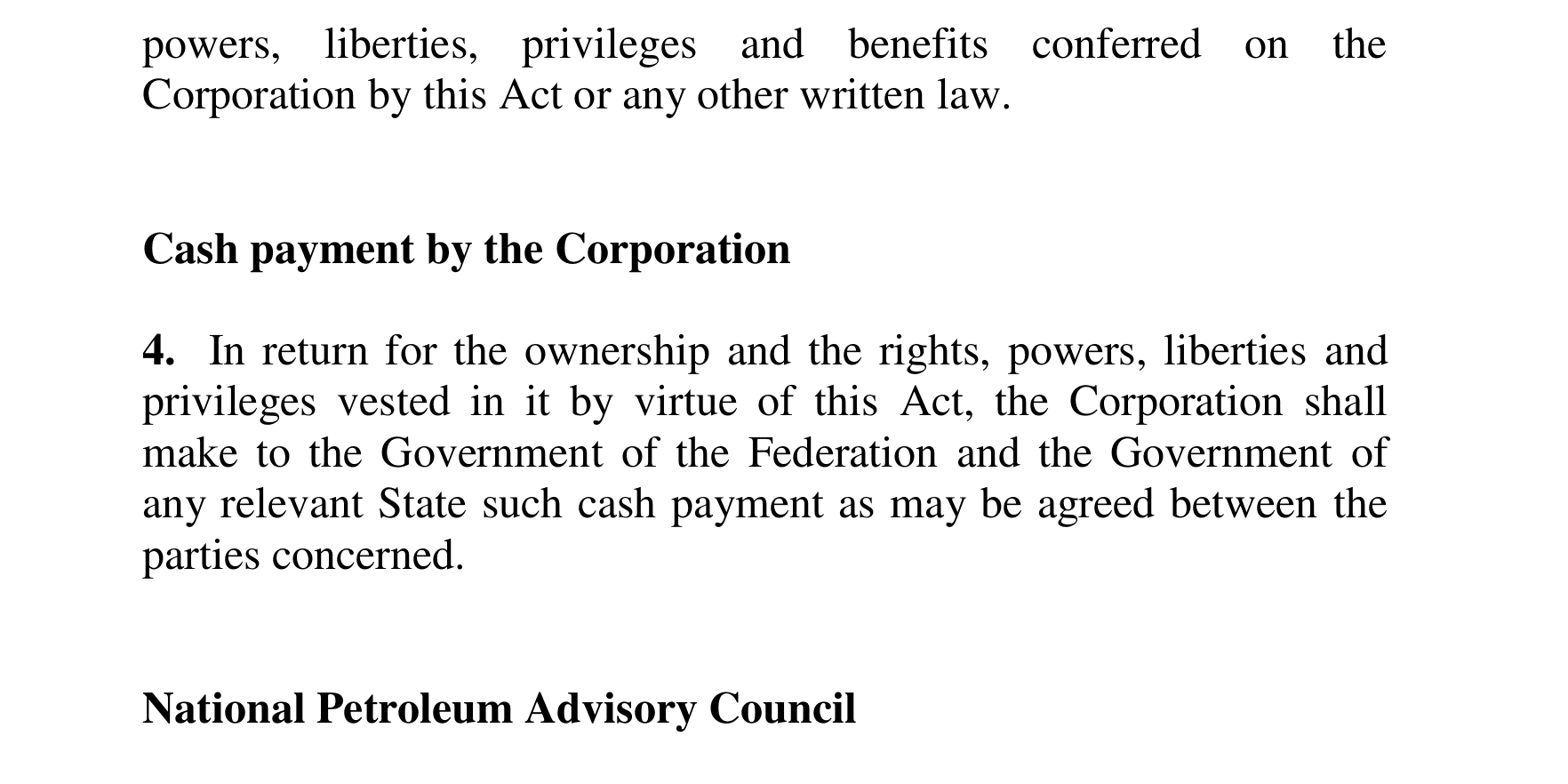
“such cash payment as may be agreed between the parties concerned — the Act sets no percentage anywhere.”
That is the entire section. Read it for what is missing: there is no percentage in it. There is no percentage anywhere in the Act. The phrase "per cent" does not appear once in the statute, from section 1 to the Schedule — we searched the full text. The only numbers in the Act are penalties and procedural deadlines.
This matters because "the 5% royalty under the Petroleum Development Act" is among the most repeated claims in Malaysian public argument, and as stated it is wrong on both nouns. The Act creates an obligation to make a cash payment and expressly leaves the amount to "such cash payment as may be agreed between the parties concerned." The 5% comes from the separate cash-payment agreements signed in 1975, which are private instruments between Petronas and each state government. We could not obtain their text from any public source, so we do not state the rate as a fact. If you see 5% cited to the Act, the citation is wrong even if the number turns out to be right.
There is a second, unrelated 5% that gets tangled with the first. Sarawak levies a State Sales Tax of 5% on petroleum products sold or delivered outside the state — crude petroleum oils, LNG, condensates and seven other tariff lines. That one is verifiable to the letter: gazetted 14 December 2018, in force 1 January 2019. It is a state tax on outward sales, not a share of Petronas' profits, and it is not what section 4 is about. Two different 5% figures, two different mechanisms, routinely merged into one grievance.
Where the money does go
Petronas paid the federal government RM32 billion in dividends in each of 2024 and 2025.
PETRONAS Audited Financial Statements 2025
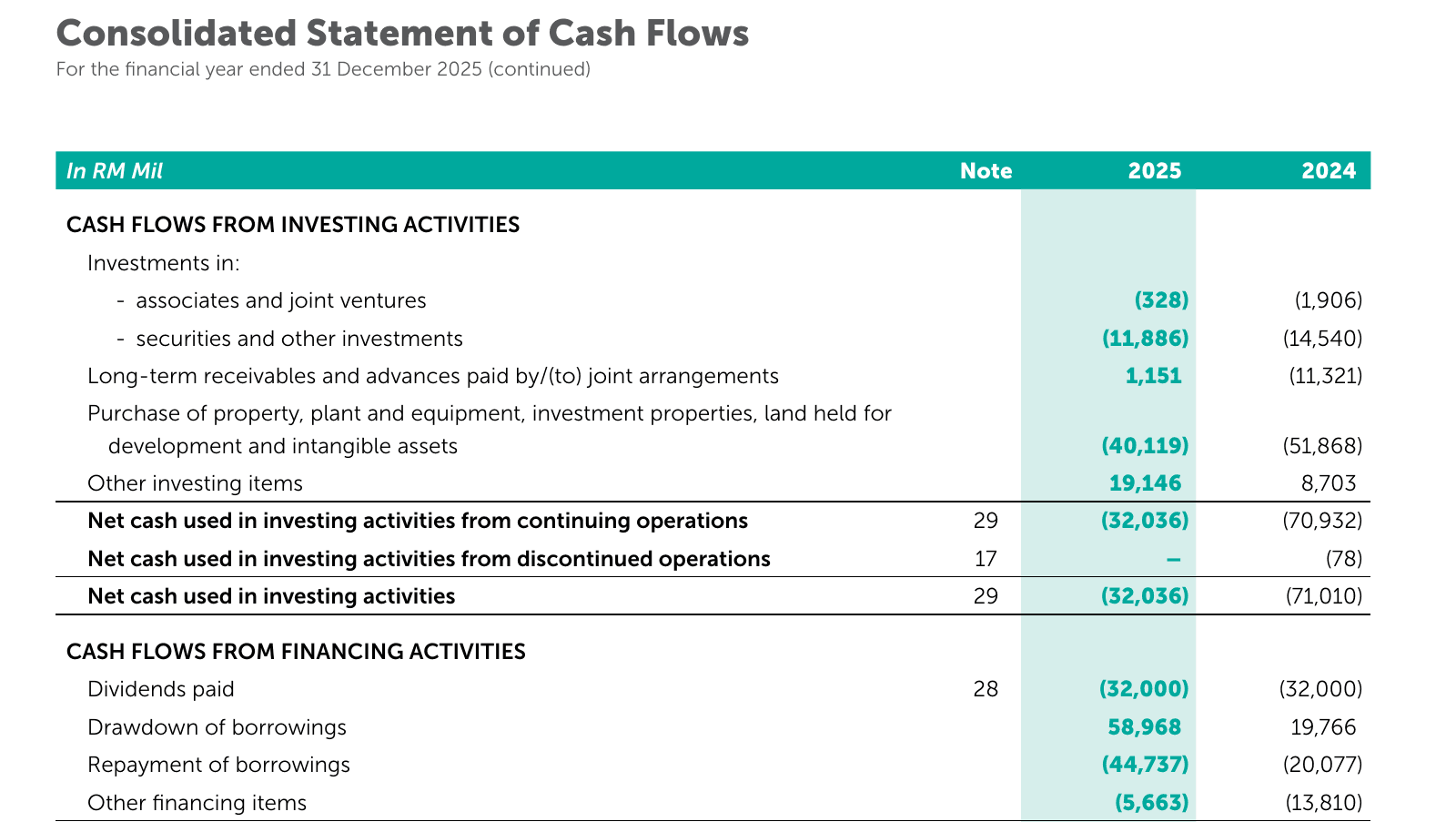
“Dividends paid 28 (32,000) (32,000)”
The more revealing number is the trend. What the Ministry of Finance calls petroleum-related revenue — the dividend plus petroleum income tax, royalties and export duty — was 31.7% of all federal revenue in 2019. For 2026 the Ministry projects RM43 billion, or 12.5%. Whatever the fight over the split is about, the pot is shrinking fast as a share of what the federal government runs on.
Fiscal Outlook and Federal Government Revenue Estimates 2026
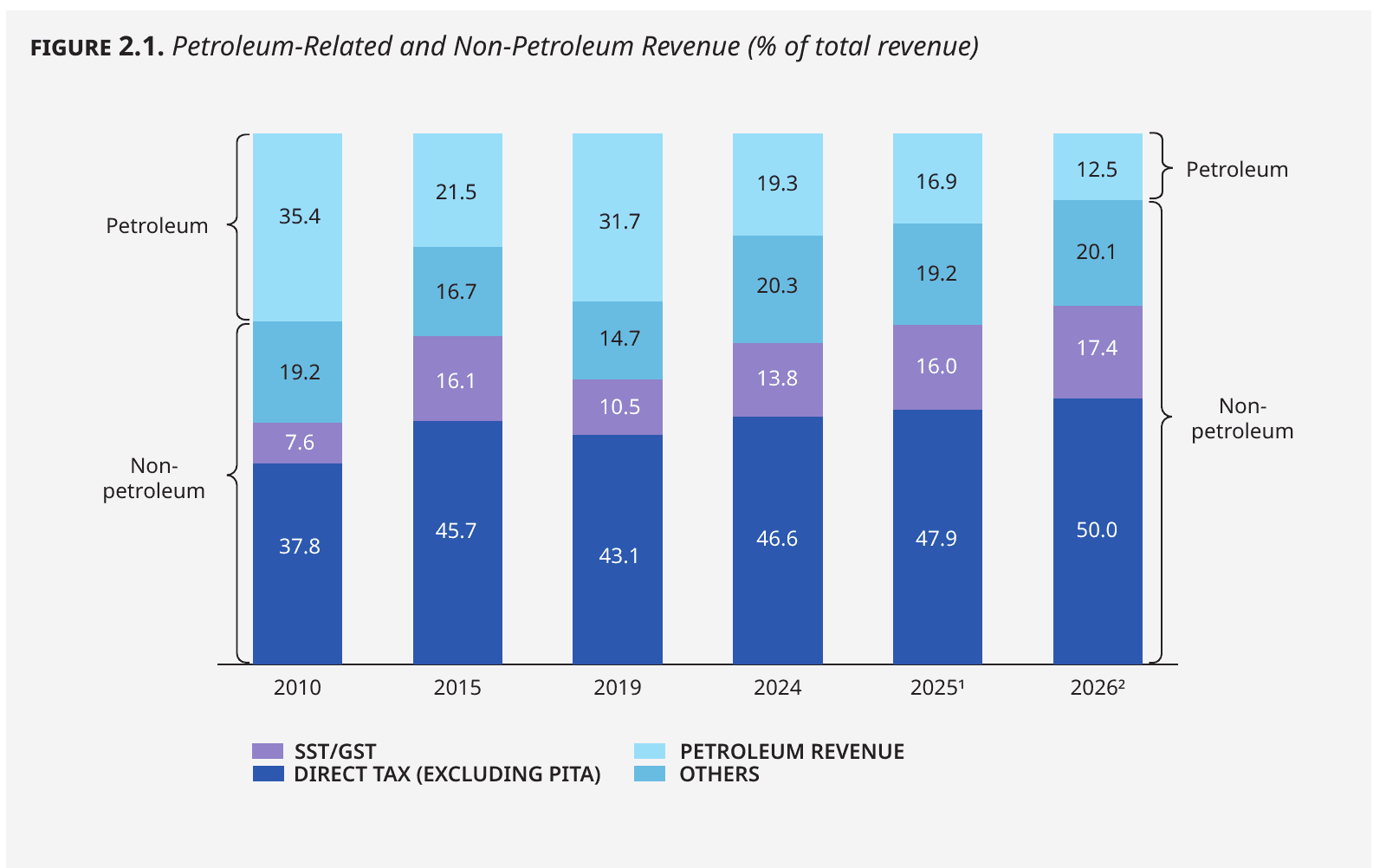
“Petroleum 35.4 (2010) · 21.5 · 31.7 (2019) · 19.3 · 16.9 · 12.5 (2026)”
Meanwhile Sarawak's state government collected RM13.3 billion in 2023, the highest revenue of any state government in Malaysia, and ran the largest surplus at RM1.9 billion. Sabah collected RM7.0 billion. For scale, Selangor — the largest state economy, with the highest household incomes — collected RM2.7 billion, and Johor RM1.9 billion.
The honest answer
The question assumes a pattern across "the oil-producing states". That pattern exists in one of them.
Sarawak is not a poor state and its government is not a poor government: it is the best-funded state government in the country, collecting nearly five times what Selangor does. What is true is that Sarawak's households earn well below the national median while living in an economy that produces well above it — and it is the only state in Malaysia of which that is true.
Sabah is a different and more serious case that this framing actually obscures. Sabah does not have a high-output, low-income problem. It has a low-output, low-income, high-poverty problem, and calling it an oil-money grievance risks answering the wrong question about the state with Malaysia's worst poverty rate.
And underneath both, nearly half of the country's extractive output sits in a statistical category belonging to nobody, which means the state-by-state ledger everyone is arguing over is missing its largest single line.
The right follow-up question is not "where did the oil money go". It is why an economy producing RM73,426 a head pays its median household RM5,504 a month — a question about the other four-fifths of Sarawak's economy, and about what RM13.3 billion of state revenue is spent on. Both have documents behind them. We will take them one at a time.
Notes on the figures. GDP per capita is at current prices; mining shares are at constant 2015 prices, so the two must not be combined into a single ratio. DOSM's GDP by State 2025 release restates 2024 national GDP per capita as RM56,772, against RM56,734 in the 2024 release used here; the revision does not change any comparison in this article. DOSM's open-data file gives Kuala Lumpur's 2024 median household income as RM10,802 while the release text gives RM10,805; every other state matches exactly across both. Poverty figures are not comparable with years before 2019, when the Poverty Line Income was revised. Percentage comparisons are our own arithmetic on the DOSM values cited above.
Not verified. The 5% cash-payment rate under the 1975 agreements — the agreements are not published and we could not obtain their text.
Get the next one
Related, by subject
The ringgit did get stronger — against eleven of fourteen currencies. The Singapore dollar was not one of them.
Bank Negara's own daily rate table, 2015 to 2025: what the ringgit did against fourteen currencies, and why the start date decides the answer.
Before Malaysia's budget pays for a single service, RM210 billion of it is already spent
Two of the government's own documents give different totals for 2026. Both are right. Here is where the money goes, in order of size.
The median Malaysian citizen's pay rose to RM2,793 in 2024. It buys what RM2,103 bought in 2010.
Malaysia's median citizen earned RM2,793 a month in 2024. Measured in 2010 ringgit it was RM2,103. Both figures are DOSM's own.